Some of you might have been expecting part two of my articles on How COVID-19 Has Impacted Healthcare Students Across The World but truth be told, I was a little bit stressed this week and had a mini meltdown (I was stressed about literally nothing… drama queen!). Part two has taken me a little bit longer than I expected but will definitely be up next week and explores the experiences of a medical student from Newcastle (the Australian Newcastle) and a recently qualified nurse from the Kingdom of Tonga!
I’ll try not to make it too scientific or boring, so I’ll keep it short and do my best not to sound like a journal article. The information in this post is correct at the time of posting (on the 06 June 2020) and sourced mainly from the article Features, Evaluation and Treatment Coronavirus (COVID-19), published on the 18 May 2020. A link to this article can be found at the end of the post!
SARS-CoV-2 is the official name of the virus wreaking havoc across the world today by causing the disease known as COVID-19. SARS stands for Severe Acute Respiratory Syndrome. The SARS outbreak of 2002-3 was caused by a different form of virus. CoV is an abbreviation for Corona Virus, the family of viruses which SARS-CoV-2 comes from. The ‘2’ is the number used to differentiate it from the virus that the caused the SARS outbreak in 2002-3 as these are different (though similar in very basic terms) viruses.There are no currently known cures for COVID-19 and the treatment for COVID-19 is therapeutic measures. This includes things such as oxygen therapy and anti-emetics (temperature-lowering medications).
As with many respiratory pathogens, SARS-CoV-2 is believed to be transmitted by droplets. This means that anyone coughing, sneezing (or even talking in some cases!) can cause droplets containing the virus to transmit directly to another person or onto surfaces. The virus can also spread through aerosol transmission, though this usually only occurs during certain procedures in a hospital environment.
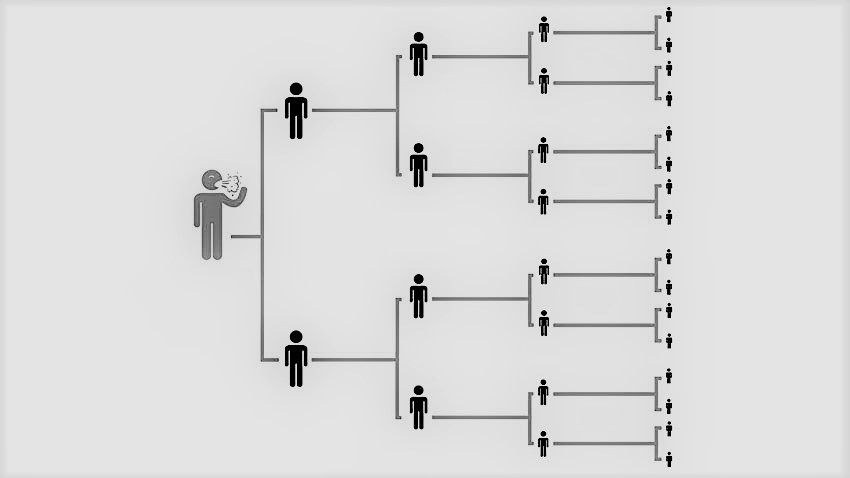
Current data suggests that SARS-CV-2 can live on certain surfaces for up to 2 days. Though future studies may reveal different results it is important to keep this in mind as it is the information we currently have available. SARS-CoV-2’s current suggested reproduction number is 2.2. This means that it is estimated that every person who contracts SARS-CoV-2 spreads the virus to approximately 2.2 other people. This was seen before lock-down measures were introduced, when numbers of SARS-CoV-2 were doubling every day around the world. The fact that it can live on surfaces for a number of days and spreads to people so quickly freaks me out. But no need for alarm, if we consistently practice our hand hygiene all will be well in the world.
Having said that, the other crucial element to preventing the spread of SARS-CoV-2 is staying home! Although lock-down restrictions are starting to ease, it is still important to remember the virus has not been completely eliminated. If you are out and about you might be interested to know about contact tracing. In Australia contact tracing is carried out separately by each state. Someone will call you from your relevant state department.
Firstly, they’ll confirm you were in contact with a COVID-19 positive person (without identifying the positive patient). The person calling will then ask you a series of questions about your health to assess whether you will need a COVID-19 test. The current test or COVID-19 is a nasopharangeal swab which involves swabbing the back of your throat as well as the back of your nasal passage (do NOT try this at home – only a trained healthcare professional can administer this test). Based on the questions you’ll be directed to self-isolate. Meaning no shops, no school runs or socialising but your contact with your relevant department will provide you with some resources to assist with these challenges. They’ll then keep in contact with you everyday, either via text or phone call.
If your test is positive, you’ll be instructed on how to self-isolate and things you can do to manage your symptoms, as well as what to do if your symptoms worsen. If your test is negative, you will able to go about your business with respect to current lock-down restrictions, or depending on the circumstances of your exposure you may need to stay isolated and continue retesting.
I know there’s some debate about Australia’s COVID-Safe app so I won’t dive into the specifics here but it’s another way of assisting in the contact tracing process if you are going out and about. I have downloaded it!
I hope this hasn’t caused anyone too much distress. I’m sure that as time passes, new knowledge will come to light so please stay up to date with the best current (and tested) information. The journal article where much of this information has been sourced can be found at: https://www.ncbi.nlm.nih.gov/books/NBK554776/?report=classic and contains many more interesting insights. Thanks to my teachers for passing on this article! If yu find any other helpful or more current evidence, I would love to see it! Please send me a message or comment below so we can continue to build our knowledge. ‘Stay alert but not anxious’ and practice your hand hygiene.
 Daisy Azmi
One thought on “The Spread of COVID-19 and How Contact Tracing Works”